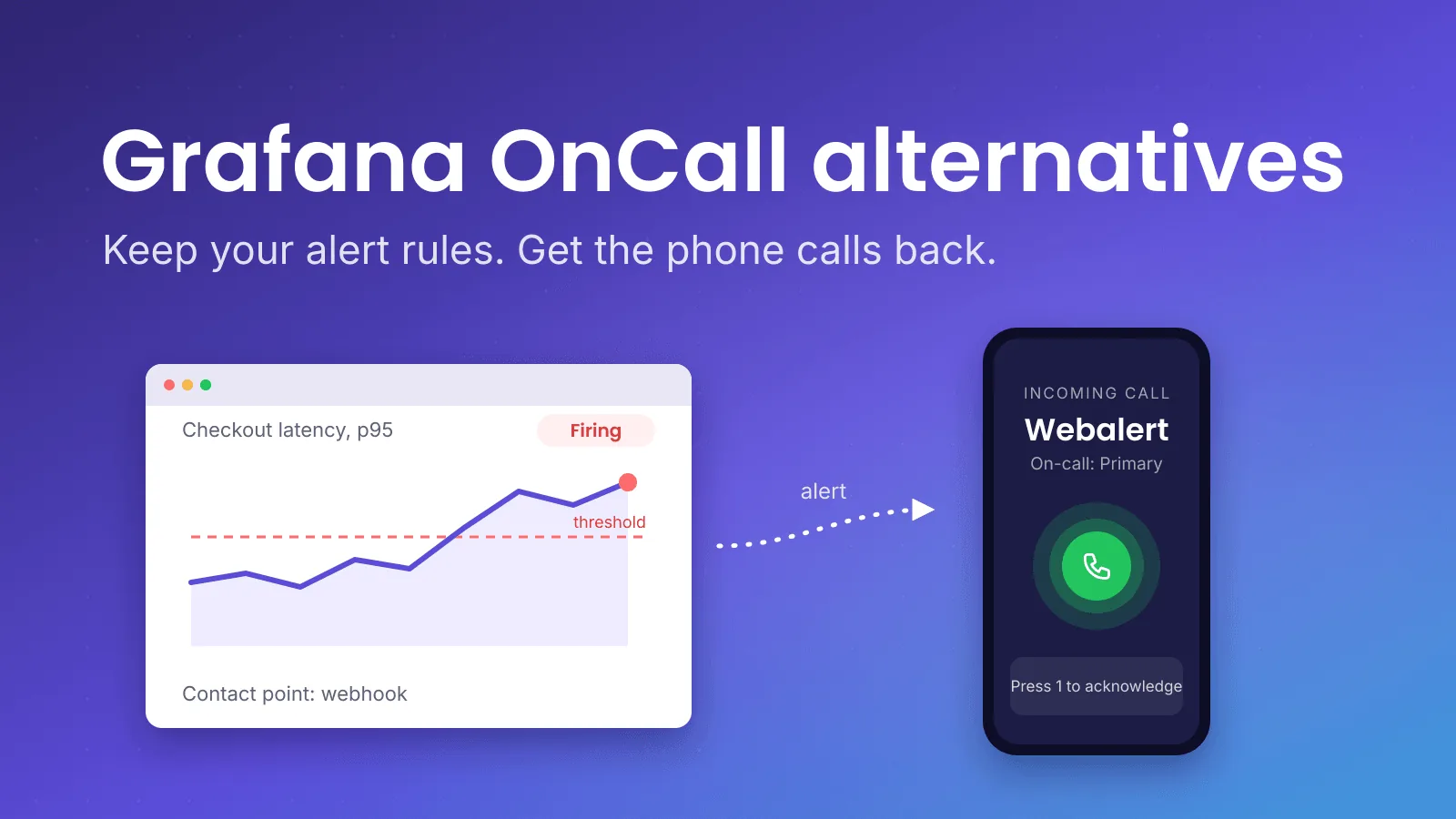
If you self-host Grafana OnCall, the ground has moved under you twice. Grafana put OnCall OSS into maintenance mode on 11 March 2025, and it has since been archived. On 24 March 2026 the Grafana Cloud connection that OSS used for SMS, phone calls and push notifications stopped working. A self-hosted OnCall that still runs today either has its own phone provider or webhook workflow wired in, or it no longer sends SMS or calls.
This post is for teams in that position who want phone and SMS paging back. The good news is that you don't have to touch your alert rules. Grafana Alerting keeps deciding what is wrong; you only replace the layer that decides who to wake up and how.
We build Webalert, which is one of the options below. Competitor facts come from vendor pages and docs checked on 26 November 2026.
What changed, with dates
- 11 March 2025: Grafana OnCall (OSS) enters maintenance mode. From then on Grafana shipped only critical bug fixes and CVEs with a CVSS score of 7.0 or higher, and no new features.
- 21 April 2025: the Grafana OnCall (Cloud) and Grafana Incident apps are sunset, and their customers move to the unified Grafana Cloud IRM app.
- 24 March 2026: the Cloud Connection ends. Grafana's post says its APIs, Cloud Connection and other services stop working with OnCall OSS after this date, and the Grafana IRM mobile app stops working with self-hosted OSS. The grafana/oncall README says OSS was archived on that date. The GitHub repository banner gives a later archive date, but either way the repo is now read-only.
Two things did not happen, and they matter for your choice:
- Grafana Cloud IRM did not drop phone or SMS. Its current docs say there are no additional costs for outgoing calls or SMS notifications. The phone and SMS loss applies to self-hosted OSS that relied on the Cloud Connection.
- OnCall OSS is still open source under AGPLv3. Grafana said it would not try to prevent forks. We found no established, actively maintained community fork.
Keep Grafana Alerting, swap the paging layer
Grafana Alerting sends notifications through contact points. The list includes Grafana IRM, PagerDuty, Opsgenie, VictorOps, Pushover, Slack, Microsoft Teams, Telegram, email and a generic Webhook, among others.
The Webhook contact point is the one that connects Grafana to almost anything. It can authenticate with Basic auth or an Authorization header (Bearer by default), sign requests with HMAC-SHA256, and send resolved notifications by default, so the receiving tool can close the incident when the alert clears. Each notification carries the alert's labels, annotations, status, start and end times and a fingerprint.
So the question is not "what replaces Grafana," but "which tool sits behind the contact point."
Option 1: Grafana Cloud IRM
The direct successor. It is Grafana's own product, it has a native contact point, and it is the closest to how OnCall worked, including alert groups.
- Price: Free for up to 3 active IRM users a month, no credit card. Pro is a $19 monthly platform fee that includes 3 active users, then $20 per active user. Enterprise starts at a $25,000 yearly commit.
- Phone and SMS: no extra cost. Paid plans cover most countries; the free tier covers fewer, but includes Denmark, Germany, the Netherlands and France.
- Billing unit: unique active users per month, not alert volume. Anyone in a schedule or escalation chain, anyone who receives a page, changes an alert group's status or edits the configuration counts.
Choose it when you already use Grafana Cloud, or when three people or fewer are on call. For a team that size it is free; PagerDuty Free is the only other $0 option in this list, and it allows up to 5 users.
Think twice when you moved to self-hosted Grafana specifically to keep data and tooling in your own hands. IRM is a hosted Grafana Cloud product.
Option 2: Keep running OnCall OSS yourself
You can. The code is AGPL and it keeps running on your servers. Grafana's own advice for self-hosters was to switch to other notification methods: a third-party provider for phone and SMS (Twilio, Exotel or Zvonok), or webhooks that trigger your own call and SMS workflows; and outgoing webhooks to Pushover, Gotify or ntfy for push.
Choose it when this is a lab, a hobby setup, or you have someone who is happy to own an unmaintained application.
Think twice when the pager is production-critical. There are no more security fixes from Grafana, no maintained fork we could find, and you now own a phone provider account, its billing and its delivery quirks. The pager is the one system that has to work when everything else is broken.
Option 3: PagerDuty
PagerDuty has a native Grafana contact point and mature scheduling and escalation.
- Price: Free for up to 5 users with 1 schedule, 1 escalation policy and 100 SMS or phone notifications a month. Professional is $25 per user per month, or $21 billed annually, with SMS and phone listed as included.
Choose it when you have several teams, high alert volume or a broader incident process. Our PagerDuty alternative guide covers where it is clearly the stronger tool.
Not an option: Opsgenie
Grafana still has an Opsgenie contact point, but Atlassian stopped selling Opsgenie in June 2025 and shuts it down on 5 April 2027. Don't move onto it now. If you are leaving Opsgenie too, see our Opsgenie alternatives for small teams.
Option 4: Webalert
Webalert is an EU uptime monitoring product with on-call: rotations with layers and overrides, escalation policies, and phone calls and SMS you acknowledge by pressing or replying 1. Grafana connects through the Webhook contact point:
- In Webalert, go to Integrations, add a Grafana integration, pick the escalation policy to page, and copy the webhook URL and credentials. The credentials are shown once.
- In Grafana, go to Alerting, Contact points, add a contact point and choose Webhook.
- Paste the URL. Under Optional Webhook settings, set the Authorization header scheme to Bearer and the credentials to the Webalert value.
- Use the contact point in a notification policy and click Test. The test shows up in the integration's activity in Webalert.
Prometheus Alertmanager works the same way with a webhook_configs receiver:
receivers:
  - name: webalert
    webhook_configs:
      - url: '<webhook URL from Webalert>'
        send_resolved: true
        max_alerts: 100
        http_config:
          authorization:
            credentials: '<credentials from Webalert>'
Step-by-step pages: Grafana and Prometheus Alertmanager.
How Grafana alerts behave in Webalert:
- Each newly firing alert instance opens an incident and pages the escalation policy. The incident title comes from the
summaryannotation. - Repeat notifications for an alert that is still firing are ignored, matched on the alert's fingerprint.
- When Grafana sends the alert as resolved, the incident resolves and escalation stops.
- A
severityorprioritylabel sets the incident severity (for examplecriticalorwarning). - By default, if more than 10 new incidents arrive from one integration within a minute, further alerts join a single storm incident that pages once.
Where it differs from OnCall: Webalert does not group alerts the way OnCall alert groups did. Each alert instance is its own incident, apart from the storm limit above. If you rely on carefully tuned alert grouping, IRM is the closer fit.
Price: on-call is €12 per responder a month (€9.60 billed yearly) on top of Starter at €9 or Business at €29. Each responder adds 30 SMS and 15 calls to a pool the team shares, and paging continues past the allowance at €0.10 per SMS and €0.40 per call. Starter includes 3 inbound integrations; Business is unlimited. The Free plan has no on-call and no inbound integrations.
Choose it when you want phone and SMS paging for Grafana alerts without running a phone provider yourself, an EU vendor, and uptime monitors and status pages in the same account. The Grafana OnCall migration guide covers the switch step by step.
Side by side for a small team
| 3 people on call | 5 people on call | Phone and SMS | |
|---|---|---|---|
| Grafana Cloud IRM | $0 (Free) | $59/month (Pro) | No extra cost |
| PagerDuty | $0 (Free, limits apply) or $75/month | $0 (Free, limits apply) or $125/month | Free: 100 a month in total. Professional: included |
| Webalert | €45/month | €69/month | 30 SMS + 15 calls per responder, shared, then billed |
| OnCall OSS, self-hosted | Your hosting and time | Your hosting and time | Your own provider's rates |
Monthly list prices checked 26 November 2026. PagerDuty and Grafana in USD, Webalert in EUR, excluding VAT. For a fuller table with 10 people and annual billing, see what on-call paging costs a 5-person team.
Frequently asked questions
Did Grafana Cloud IRM remove SMS and phone calls?
No. The loss of phone, SMS and push applies to self-hosted OnCall OSS, which used Grafana Cloud's connection for them until 24 March 2026. Grafana Cloud IRM's docs say outgoing calls and SMS have no additional cost.
Is it safe to keep running Grafana OnCall OSS?
It still runs, but Grafana no longer ships fixes and the repository is archived. For a production pager, you would also need your own phone and SMS provider. That is a lot to own for the one system that has to work during an outage.
Do I have to change my Grafana alert rules?
No. Alert rules and notification policies stay as they are. You add a contact point for the new tool and point the relevant notification policies at it.
Can I run the old and new pager side by side?
Yes. Add the new contact point alongside the old one for a subset of alerts, compare for a few days, then switch the rest. Make sure everyone on call has had a test page on their own phone before you switch off the old route.
Official sources checked
Checked on 26 November 2026. Prices are in USD and can change.
- Grafana: OnCall OSS maintenance mode announcement
- grafana/oncall repository README
- Grafana IRM phone and SMS notifications
- Grafana IRM supported countries
- Grafana Cloud pricing
- Grafana IRM invoice and active users
- Grafana contact points
- Grafana webhook notifier
- PagerDuty Incident Management pricing
Webalert details: on-call, pricing and the Grafana integration.