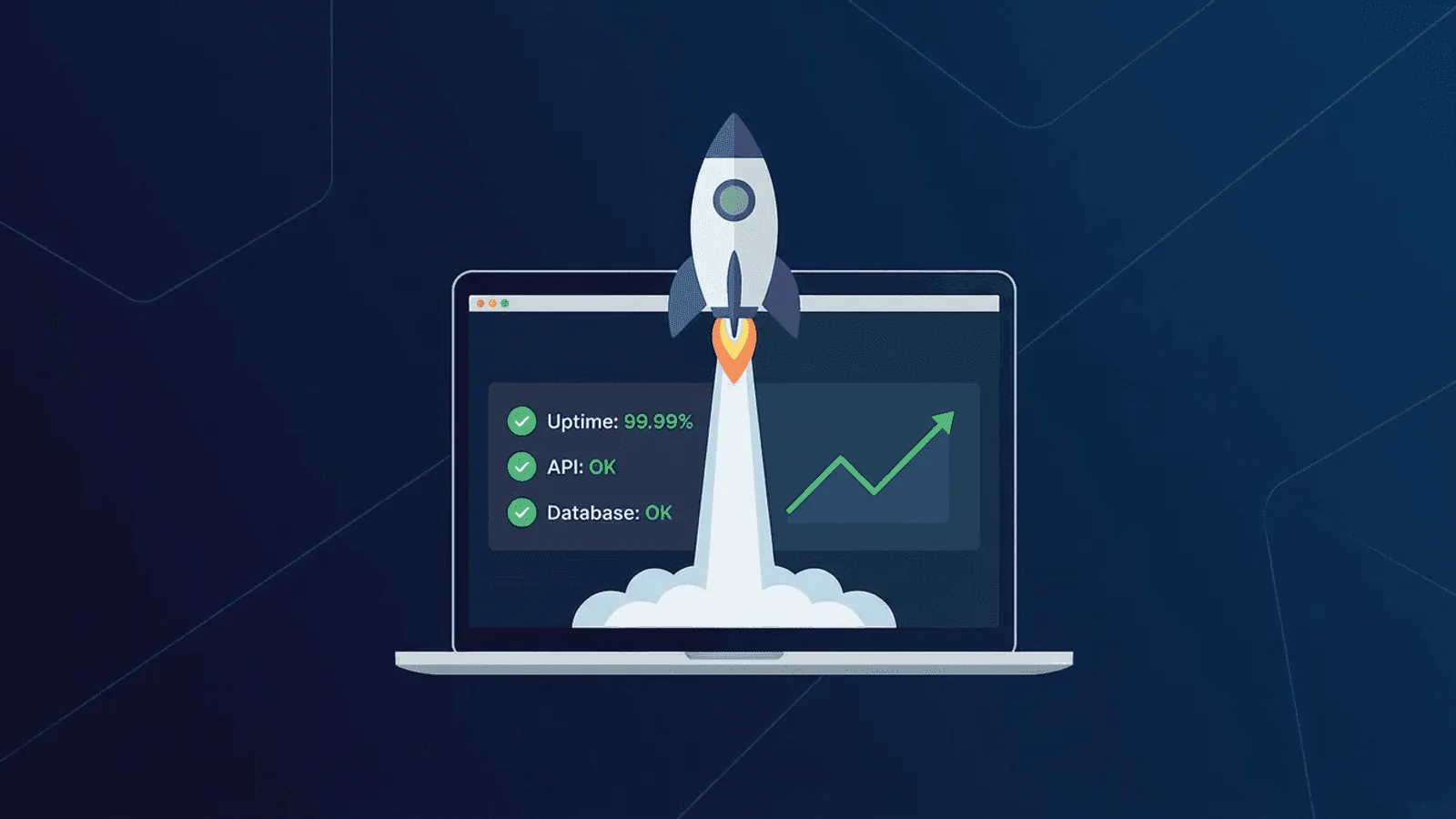
A startup does not need an enterprise observability program on launch day. It does need a reliable answer to three questions: can users complete the core journey, will the right person know when they cannot, and is there enough evidence to diagnose the failure?
Why Startups Need Monitoring Early
You have fewer users, but each one matters more
When you have 50 users, every one of them is a potential champion, case study, or churned customer. If your product is down when a new user signs up, they don't file a ticket — they leave. You'll never know they existed.
You can't watch the dashboard 24/7
Early teams are small. You're building features, talking to customers, and doing support. Nobody is watching the production dashboard at midnight. Monitoring does that for you.
Outages hit harder at the worst times
Murphy's law applies: your site will go down during your biggest traffic spike — a launch, a press mention, or a demo with a key prospect. These are exactly the moments where five minutes of downtime costs the most.
The first layer is small
An external check, one health contract, and one actionable alert route create useful coverage without a platform team.
The Startup Monitoring Stack (Keep It Simple)
Don't try to build a full observability platform on day one. Start with the minimum that catches real problems, then expand as your product and team grow.
Stage 1: One production service
What to monitor:
- Your homepage / landing page (HTTP check)
- Your API or main app URL (HTTP check)
- SSL certificate expiration
How to monitor:
- Choose an interval from the maximum acceptable detection delay
- Alerts via email and one real-time channel (Slack or SMS)
This catches broad outages, certificate failures, and obvious application errors. Add more only when a new dependency or journey creates a distinct failure mode.
Stage 2: Paying users and background work
Add:
- API health endpoint (
/healthor/api/status) that checks database connectivity - Response-time monitoring against the journey's measured baseline and objective
- A public status page (even a simple one builds trust)
Adjust:
- Move critical checks to 1-minute intervals
- Add a second alert channel (e.g., Slack + SMS)
Why now: You have paying users or active free users who depend on your product. Slow performance is now a churn risk, not just a nuisance. A status page shows you take reliability seriously.
Stage 3: Multiple services or regions
Add:
- Multi-region monitoring (check from 2+ geographic locations)
- Authenticated database and cache service metrics
- DNS monitoring
- Cron job / background task monitoring (heartbeat checks)
Adjust:
- Establish named primary and backup responders
- Create an incident response process (even a simple checklist)
- Add escalation rules: if the primary responder doesn't acknowledge in 10 minutes, alert the next person
Why now: You likely have infrastructure in multiple regions, background jobs that must run, and customers in different time zones. Single-location checks and one alert channel aren't enough anymore.
Stage 4: Contractual reliability
Add:
- Synthetic monitoring for critical user flows (signup, login, checkout)
- Third-party dependency monitoring
- Content change detection (catch defacements or injection)
- SLA tracking and uptime reporting for enterprise customers
Adjust:
- Formalize your incident communication process
- Publish uptime history on your status page
- Review monitoring coverage quarterly
Why now: Enterprise prospects check your status page before buying. Your architecture is complex enough that silent failures in dependencies or background systems can go unnoticed for hours without proper monitoring.
What to Monitor First (The Essentials)
If you do nothing else, monitor these three things:
1. Your homepage or landing page
This is the front door. If it's down, nobody can find you, sign up, or learn about your product. Monitor it with an HTTP check that verifies a 200 response.
2. Your app's main entry point
Whatever URL your users interact with — the dashboard, the API, the main app screen. This is where outages directly affect retention.
3. Your API health endpoint
Create a simple /health endpoint that returns 200 when the app is running and can reach its database. This is the single most valuable endpoint for monitoring:
GET /health
{
  "status": "ok",
  "database": "connected",
  "timestamp": "2026-02-22T10:30:00Z"
}
If the database is unreachable, return a 503. This way your uptime monitor catches both "app is down" and "app is up but the database is broken."
Alerts: Get the Balance Right
Start with two channels
- Slack (or Discord/Teams) — for awareness. The whole team sees it.
- Email or SMS — for the person who needs to act.
Don't overthink this. Two channels cover you. Add phone calls or PagerDuty later when you have a formal on-call rotation.
Avoid alert fatigue from day one
Alert fatigue makes monitoring ineffective when notifications do not require action.
Rules to prevent it:
- Only alert on things that require action.
- Confirm failures across retries or regions when the extra delay fits the detection objective.
- Set response time thresholds that match your actual performance, not aspirational targets. If your p95 is 800ms, don't alert at 500ms — you'll get constant noise.
- Review and tune alerts monthly. Turn off anything nobody acts on.
Send recovery notifications
When the issue resolves, send a "back up" notification. This closes the loop and prevents your team from investigating problems that already fixed themselves.
The Health Endpoint: Your Most Important Monitor
A good health endpoint is the single most valuable thing you can build for monitoring. It takes 15 minutes and pays for itself the first time it catches a database outage before your users notice.
What to check
At minimum:
- Application running — the endpoint itself responding proves this
- Database connected — run a simple query like
SELECT 1 - Critical dependencies — Redis connected, external API reachable (optional)
What not to put in restart health
Do not make readiness call every dependency. If a non-critical provider is slow, restarting healthy instances can amplify the incident. Monitor optional dependencies separately and degrade gracefully.
Keep liveness fast and use readiness only for conditions that should remove the instance from traffic. See health endpoint design.
Response format
Keep it simple. Return 200 when healthy, 503 when degraded:
// Healthy
HTTP 200
{ "status": "ok" }

// Degraded
HTTP 503
{ "status": "error", "message": "database unreachable" }
Your uptime monitor checks the status code. The response body gives humans context when they investigate.
Common Startup Monitoring Mistakes
Waiting for the first outage
"We'll set up monitoring when we need it" means "after our biggest customer discovers we've been down for 3 hours." The best time to set up monitoring is before you need it.
Monitoring only the happy path
Checking your homepage isn't enough. If your homepage loads but the login endpoint is broken, users are still stuck. Monitor the endpoints your users actually interact with.
Ignoring SSL certificates
An expired SSL certificate makes your site unreachable and shows a scary browser warning. Set up certificate expiry alerts at 30, 14, and 7 days. This takes 30 seconds and prevents one of the most embarrassing outage types.
No status page
When your site is down, users want to know: is it just them, do you know about it, and when will it be fixed? Without a status page, they have nowhere to check. A simple status page at status.yourapp.com answers all three questions.
Over-monitoring too early
You don't need distributed tracing, custom metrics dashboards, and log aggregation in week one. Start with HTTP uptime checks and SSL monitoring. Add more as your infrastructure and team grow. Premature complexity is a time sink.
Only one alert channel
If alerts only go to a Slack channel that nobody checks on weekends, you don't have monitoring on weekends. Add at least one push channel (SMS, phone call, or mobile push) for critical alerts.
How to Choose a Monitoring Tool as a Startup
What matters for early-stage teams:
Fast setup
You should be able to add a monitor in under 2 minutes. If the tool requires agents, SDKs, or infrastructure changes, it's too heavy for now.
Free tier that's actually useful
You need at least 5-10 monitors on the free plan — enough to cover your critical endpoints. A free tier with 1 monitor and 10-minute checks isn't useful.
Alert channels you already use
If your team lives in Slack, the tool should alert in Slack. If you need SMS for after-hours, it should support SMS. Don't adopt a tool that only alerts via email if nobody checks email at midnight.
Status page included
Running a separate status page tool adds cost and complexity. A monitoring tool with a built-in status page simplifies your stack.
Room to grow
You'll need more monitors, faster checks, and additional features (TCP, DNS, on-call) as you scale. Choose a tool that grows with you so you don't have to migrate later.
How Webalert Fits the Startup Playbook
Webalert is built for teams that want reliable monitoring without the complexity or cost of enterprise platforms:
- Free plan — Start with multiple monitors, no credit card. Enough to cover Stage 1 and 2.
- 2-minute setup — Add a URL, choose your alert channels, done.
- HTTP, TCP, DNS, ping, SSL, cron — All the check types in one tool. No need for multiple services.
- Slack, email, SMS, Discord, Teams, webhooks — Alert where your team already works.
- Built-in status page — Public status page included with every plan. Custom domain support on paid plans.
- 1-minute checks — Catch issues faster on paid plans when your user base grows.
- On-call scheduling — Add rotation when you have 2+ engineers. Escalation included.
- Multi-region monitoring — Verify availability from global locations as your user base expands.
Start free, upgrade when you need it. No contracts, no sales calls, no configuration marathons.
See features and pricing for the full details.
The 10-Minute Startup Monitoring Checklist
Do this today:
- Sign up for a monitoring service (free tier is fine)
- Add your homepage as an HTTP monitor
- Add your app/API URL as a second HTTP monitor
- Enable SSL monitoring for your domain
- Connect Slack (or your team's chat tool) for alerts
- Add an email or SMS alert as a backup channel
- Create a
/healthendpoint that checks database connectivity - Add the health endpoint as a third HTTP monitor
- (Optional) Set up a public status page
- (Optional) Bookmark your monitoring dashboard
That's it. You now have more visibility into your production environment than most startups twice your size.
Summary
Monitoring isn't an enterprise thing. It's a "I want to know when my product breaks" thing.
- Start simple — HTTP checks on 2-3 URLs, SSL monitoring, and Slack alerts.
- Build a health endpoint — 15 minutes of work that catches database failures before users do.
- Avoid alert fatigue — Only alert on things that need action. Tune aggressively.
- Add a status page — Even a simple one builds trust and reduces support load.
- Grow with your product — Add TCP, DNS, multi-region, and on-call as you scale.
The startups that take reliability seriously from day one are the ones that keep their users when it matters most.