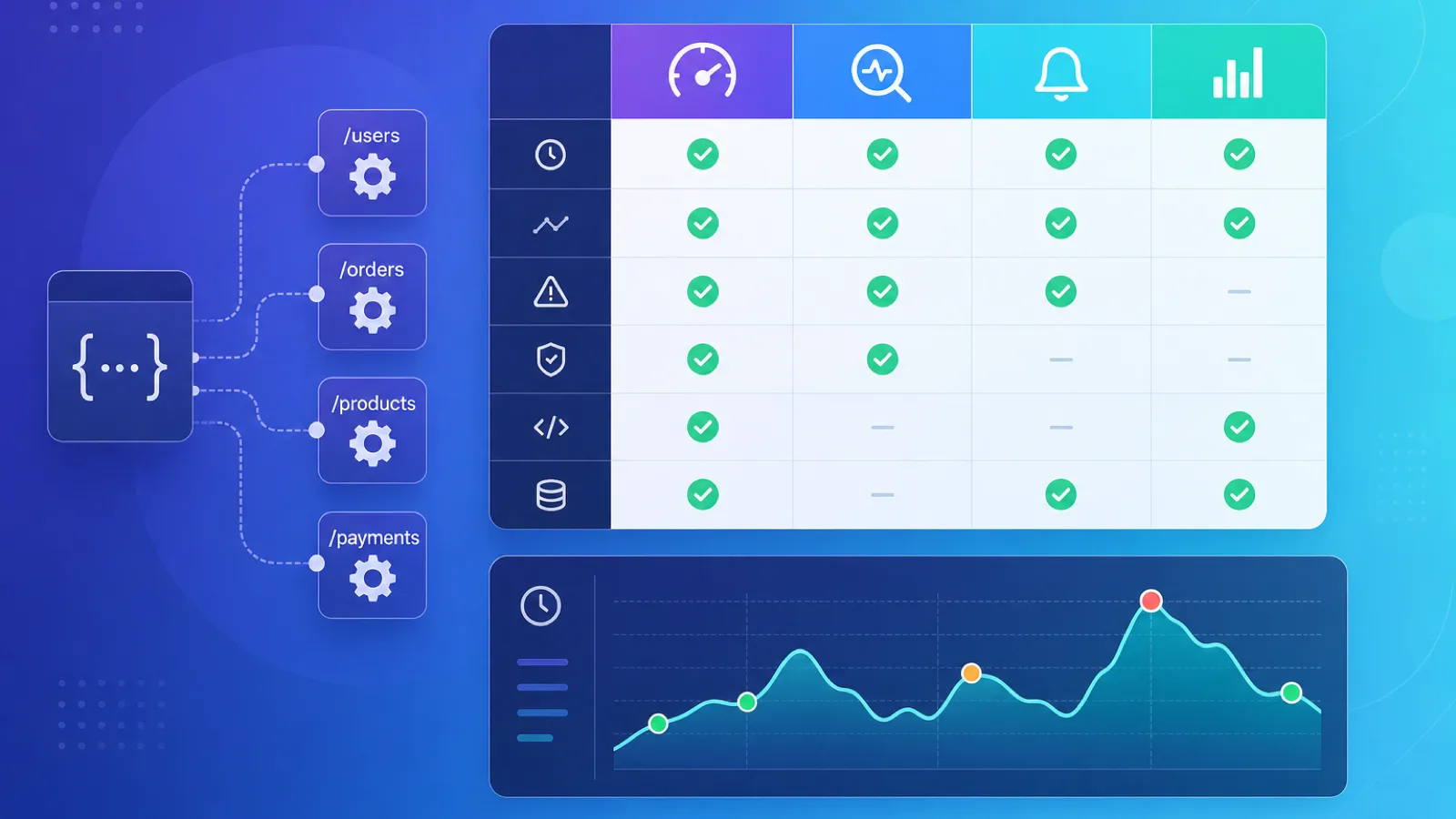
API monitoring covers a wide spectrum. At one end is the simplest question — "is this endpoint returning 200?" — which a basic uptime check answers in seconds. At the other end is multi-step synthetic testing with response-body assertions, authentication flows, and correlation with backend traces. The tools that serve these ends are not the same tool, and the mistake teams make is buying the deep-synthetic platform when all they needed was an endpoint health check, or vice versa.
In 2026 the field has settled into clear tiers: full-stack observability platforms that bundle API monitoring with APM and logs, developer-first synthetic tools that live in code and CI, simple uptime monitors that do endpoint health at low cost, and self-hosted options for teams that want full control. This guide compares the best API monitoring tools in 2026 across those tiers so you can match the tool to the depth of validation your APIs actually need.
This is not a ranked list where one tool wins. It is a comparison by use case, because the right pick depends entirely on whether you need a status-code check, response-body validation, or full APM correlation.
The Two Questions That Decide Your Tier
How deep does your validation need to go?
- Status-code only — you need to know whether the endpoint returns 200 and responds within a time threshold. Simple uptime monitoring covers this.
- Response-body assertions — you need to validate specific JSON fields, header values, or multi-step authentication flows. This narrows the field to synthetic tools.
- APM correlation — you need to connect a failed API test to backend traces, logs, and infrastructure metrics. This points to full-stack observability platforms.
What is your team's primary workflow?
- Already on an observability platform — Datadog or New Relic, where API monitoring is one layer.
- Developer-first, code-defined — Checkly or Postman, where checks live near the code.
- Simple and affordable — UptimeRobot or Webalert, for endpoint health without scripting.
- Self-hosted — Uptime Kuma, for full control at zero license cost.
Answer those two and the field narrows to one or two tools. The comparisons below expand on each tier.
Tier 1: Full-Stack Observability Platforms
These tools bundle API monitoring with APM, logs, and infrastructure metrics. They are the right pick when API monitoring is one layer in a wider observability strategy and you want failed tests correlated with backend traces.
Datadog API Monitoring
The standard choice for teams already standardized on Datadog. Failed synthetic API tests correlate directly with backend traces, logs, and infrastructure metrics. Pricing is usage-based — infrastructure from around $15/host/month plus synthetic run pricing — which becomes expensive at high frequency. Best for teams that already run Datadog and want API monitoring in the same platform.
New Relic Synthetics
The other full-stack option, with a generous free tier and usage-based pricing on top. Strong for teams balancing product and infrastructure visibility. Like Datadog, it is the right pick when you are already on New Relic; standing it up just for API monitoring is overkill.
Best for: teams already on an observability platform that want API monitoring correlated with APM and logs. Watch out for: usage-based pricing that climbs at high check frequency, and complexity that exceeds the needs of a team that just wants endpoint health.
Tier 2: Developer-First Synthetic Monitoring
These tools live in code and CI/CD. They are the right pick when your team writes tests and wants the same script to run in CI and as a synthetic monitor.
Checkly
The leading code-defined synthetic monitor, built on Playwright. API and browser checks managed via CLI, Git, and CI/CD pipelines, with monitoring-as-code in TypeScript. The killer feature is that the same script runs in CI and production. Pricing is per-run, which is fine at low volume but scales steeply — a 30-second browser check from three regions is roughly 259,200 billable runs per month. No native on-call or status page; SSO requires Enterprise.
Postman Monitors
The lowest-friction option if your team already builds and tests APIs in Postman. Existing collections promote to monitors that run on a cadence and alert on assertion failure. The moat is integration with Postman's docs and mock servers. Less useful if you are not already in the Postman ecosystem.
Best for: developer teams that want code-defined synthetic monitoring with CI/CD integration. Watch out for: per-run billing (Checkly) and authoring that assumes a developer maintaining scripts.
Tier 3: Simple API Uptime Monitoring
These tools do endpoint health checks without scripting. They are the right pick when "is my API returning 200?" is the question and multi-step validation is overkill.
Webalert
A hosted, multi-region uptime monitor that covers API endpoint health with HTTP/HTTPS checks, keyword and content checks, and authenticated endpoints (bearer tokens, custom headers). Prices per monitor, not per run, so a 30-second check from multiple regions is one monitor rather than a quarter-million billable executions. Ships a status page, on-call, and incident management in the same product — the things Checkly and UptimeRobot leave to a separate vendor. SSL, DNS, and domain monitoring catch the upstream causes of API outages alongside the endpoint check itself.
UptimeRobot
The simplest, most affordable option for basic endpoint health checks. A generous free tier (50 monitors) and an affordable paid path. HTTP keyword and JSON checks cover status-code-level validation. No multi-step API checks, no browser checks, and no bundled incident management — it is a pure uptime monitor. Best for teams that need the simplest possible setup and whose checks are status-code-only.
Best for: teams that need endpoint health checks without scripting or per-run billing. Watch out for: no multi-step validation or browser checks — if you need response-body assertions, move up a tier.
Tier 4: Self-Hosted and Open-Source
Uptime Kuma
The go-to for completely free, self-hosted API monitoring. Open-source, full control, no license cost. Supports HTTP, TCP, ping, DNS, and more. No multi-step API checks, no browser checks, and you operate the infrastructure yourself — which means the monitor's own downtime is your problem. Best for teams that want $0 cost and are willing to host it.
Best for: teams that want free, self-hosted monitoring and can operate the infrastructure. Watch out for: the monitoring paradox — if your self-hosted monitor goes down with your server, you do not get alerted. Pair with an external check for the monitor itself.
Comparison Table
| Tool | Tier | Multi-step API | Free tier | Starting price | Status page | On-call |
|---|---|---|---|---|---|---|
| Datadog | Observability | Yes | Limited | ~$15/host + runs | No | Yes |
| New Relic | Observability | Yes | Yes | Usage-based | No | Yes |
| Checkly | Synthetic | Yes | 5–10 checks | ~$24–40/mo (per run) | No | No |
| Postman | Synthetic | Yes (collections) | 1,000 calls/mo | ~$14/user/mo | No | No |
| Webalert | Simple uptime | No | Yes | Per monitor | Yes | Yes |
| UptimeRobot | Simple uptime | No | 50 monitors | ~$7–9/mo | Basic | No |
| Uptime Kuma | Self-hosted | No | Fully free | $0 (self-host) | Yes | No |
The pattern: depth of validation and platform breadth trade off against simplicity and cost. The deeper the validation, the more you pay in money, complexity, or both.
How to Choose
If you only need "is my API returning 200?"
A simple uptime monitor is sufficient. Webalert or UptimeRobot cover endpoint health at low cost without scripting. Pick Webalert if you want a status page, on-call, and incident management bundled; pick UptimeRobot if you want the absolute simplest, cheapest setup and nothing else.
If you need response-body assertions or multi-step flows
Move to a synthetic tool. Checkly is the pick if you write code and want monitoring-as-code with CI/CD integration. Postman is the pick if your team already lives in Postman collections.
If you need APM correlation
Pick the observability platform you already use. Datadog or New Relic correlate failed API tests with backend traces and logs, which is the value — but you pay observability-platform prices for it.
If you want zero license cost and can self-host
Uptime Kuma is the standard. Pair it with an external check so the monitor's own downtime does not leave you blind.
The honest hybrid
Many teams run a simple uptime monitor for endpoint health and a synthetic tool for the few multi-step flows that need it. That hybrid is legitimate and often cheaper than forcing one tool to do both jobs.
Frequently Asked Questions
What is the best API monitoring tool in 2026?
There is no single best — it depends on validation depth. For simple endpoint health, Webalert or UptimeRobot. For code-defined synthetic with assertions, Checkly or Postman. For APM correlation, Datadog or New Relic. For free self-hosted, Uptime Kuma. Match the tool to the depth you need.
Do I need multi-step API monitoring?
Only if you need to validate response bodies, multi-step authentication flows, or chained requests. If "is my API returning 200?" is enough, a simple uptime monitor covers it at a fraction of the cost and complexity.
Is free API monitoring enough?
For status-code-only checks on a small number of endpoints, yes — UptimeRobot's free tier or Uptime Kuma covers it. The moment you need response-body assertions, multi-step flows, or on-call and incident management, you outgrow the free tier.
What about per-run billing?
Some synthetic tools bill per execution, which scales steeply at high frequency. If your checks are simple endpoint health, a per-monitor or flat-priced tool avoids the per-run cost trap entirely.
Can I run a simple monitor and a synthetic tool together?
Yes, and many teams do. A simple uptime monitor for endpoint health, status pages, and on-call, plus a synthetic tool for the few multi-step flows that need it, is a common and cost-effective hybrid.
Pick the Tier That Matches Your Validation Depth
The most expensive mistake in API monitoring is buying a deep-synthetic platform when all you needed was an endpoint health check — or forcing a simple tool to do multi-step validation it was never built for.
Start API monitoring — free. Multi-region endpoint health checks, authenticated APIs, status pages, and on-call in one product, priced per monitor — so you get the reliability signal without per-run billing or a synthetic scripting burden you may not need.